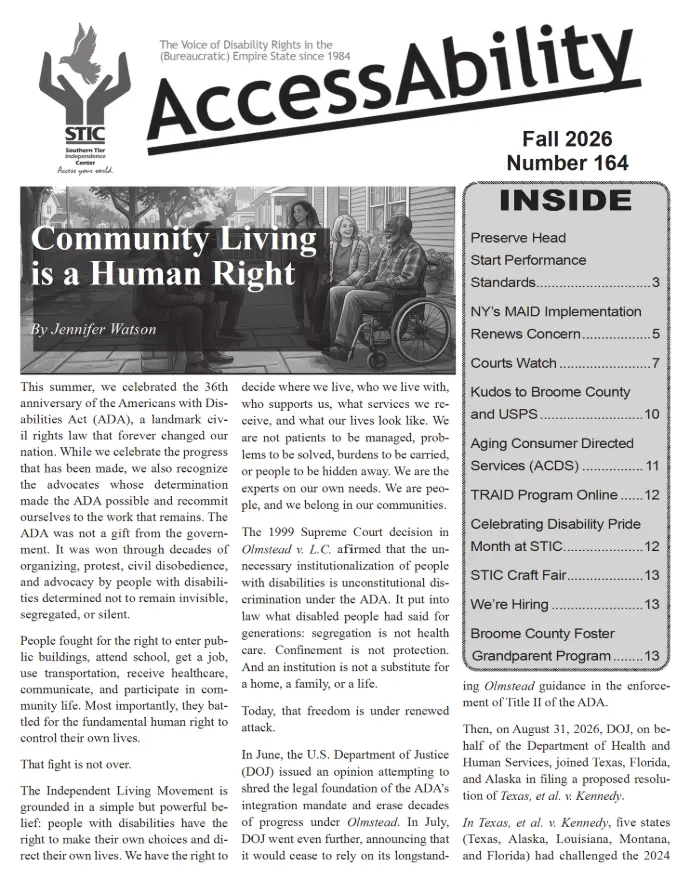
Community Living is a Human Right
by Jennifer Watson
This summer, we celebrated the 36th anniversary of the Americans with Disabilities Act (ADA), a landmark civil rights law that forever changed our nation. While we celebrate the progress that has been made, we also recognize the advocates whose determination made the ADA possible and recommit ourselves to the work that remains. The ADA was not a gift from the government. It was won through decades of organizing, protest, civil disobedience, and advocacy by people with disabilities determined not to remain invisible, segregated, or silent.
People fought for the right to enter public buildings, attend school, get a job, use transportation, receive healthcare, communicate, and participate in community life. Most importantly, they battled for the fundamental human right to control their own lives.
That fight is not over..
CONTINUE READING
Preserve Head Start Performance Standards
by Tara Ayres, Stephanie Quick, Karen Roseman, Sue Ruff, John Rzepka, Shannon Smith, and John McNulty
The Department of Health and Human Services, which administrates the Head Start program, has published a proposal – Reducing Federal Burden for Head Start Programs – that would comprehensively “rescind and replace” the performance standards that govern Head Start. STIC has grave concerns about this new direction for Head Start..
CONTINUE READING
NY's MAID Implementation Renews Concern
STIC has expressed grave reservations about dangers in the application of Medical Aid in Dying (MAID) protocols, both in general and specifically regarding the population we are dedicated to serving, people with disabilities. The disability population has long experienced systemic discrimination in healthcare, housing, education, and broader social attitudes. MAID, we fear, may set a dangerous precedent by implicitly reinforcing the notion that some lives may be of lesser value than others. This undermines efforts towards equity, inclusion, and equal access to care in general..
Fall 2025
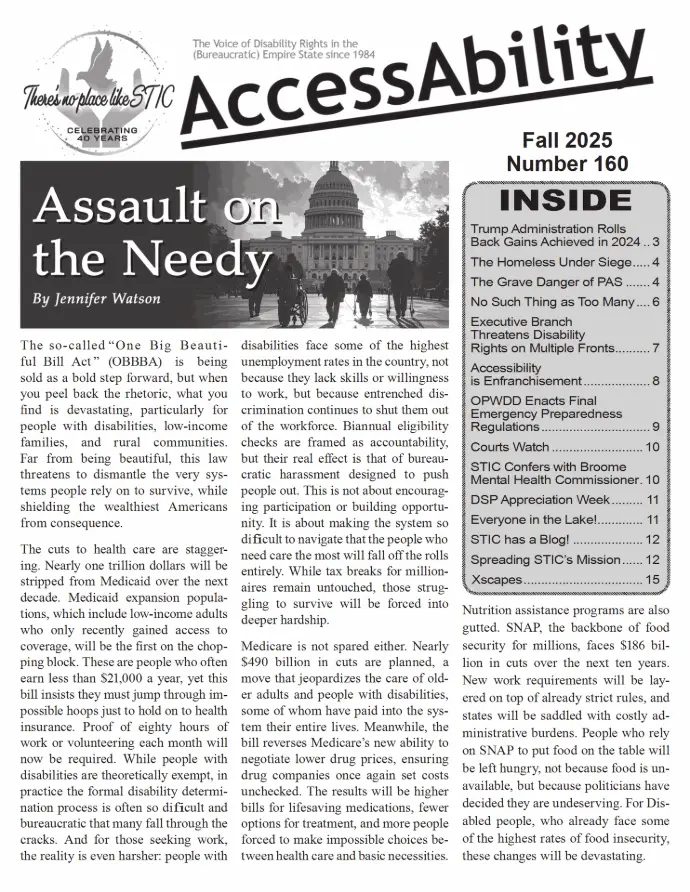
Assault on the Needy
by Jennifer Watson
The so-called “One Big Beautiful Bill Act” (OBBBA) is being sold as a bold step forward, but when you peel back the rhetoric, what you find is devastating, particularly for people with disabilities, low-income families, and rural communities. Far from being beautiful, this law threatens to dismantle the very systems people rely on to survive, while shielding the wealthiest Americans from consequence..
Winter 2025-26
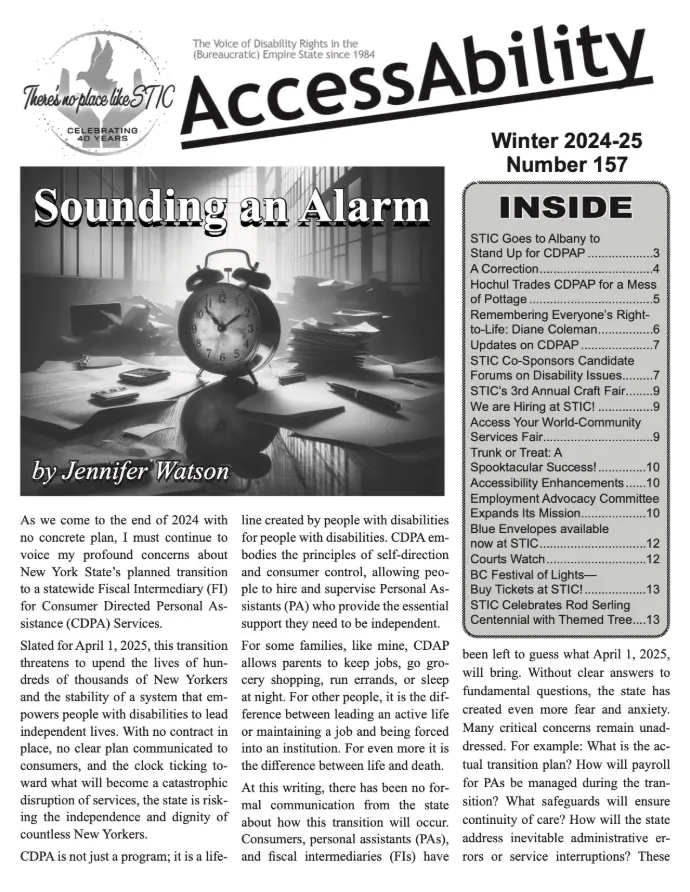
Sounding the Alarm
By Jennifer Watson
As we come to the end of 2024 with no concrete plan, I must continue to voice my profound concerns about New York State’s planned transition to a statewide Fiscal Intermediary (FI) for Consumer Directed Personal Assistance (CDPA) Services. Slated for April 1, 2025, this transition threatens to upend the lives of hundreds of thousands of New Yorkers and the stability of a system that empowers people with disabilities to lead independent lives..
Spring 2026
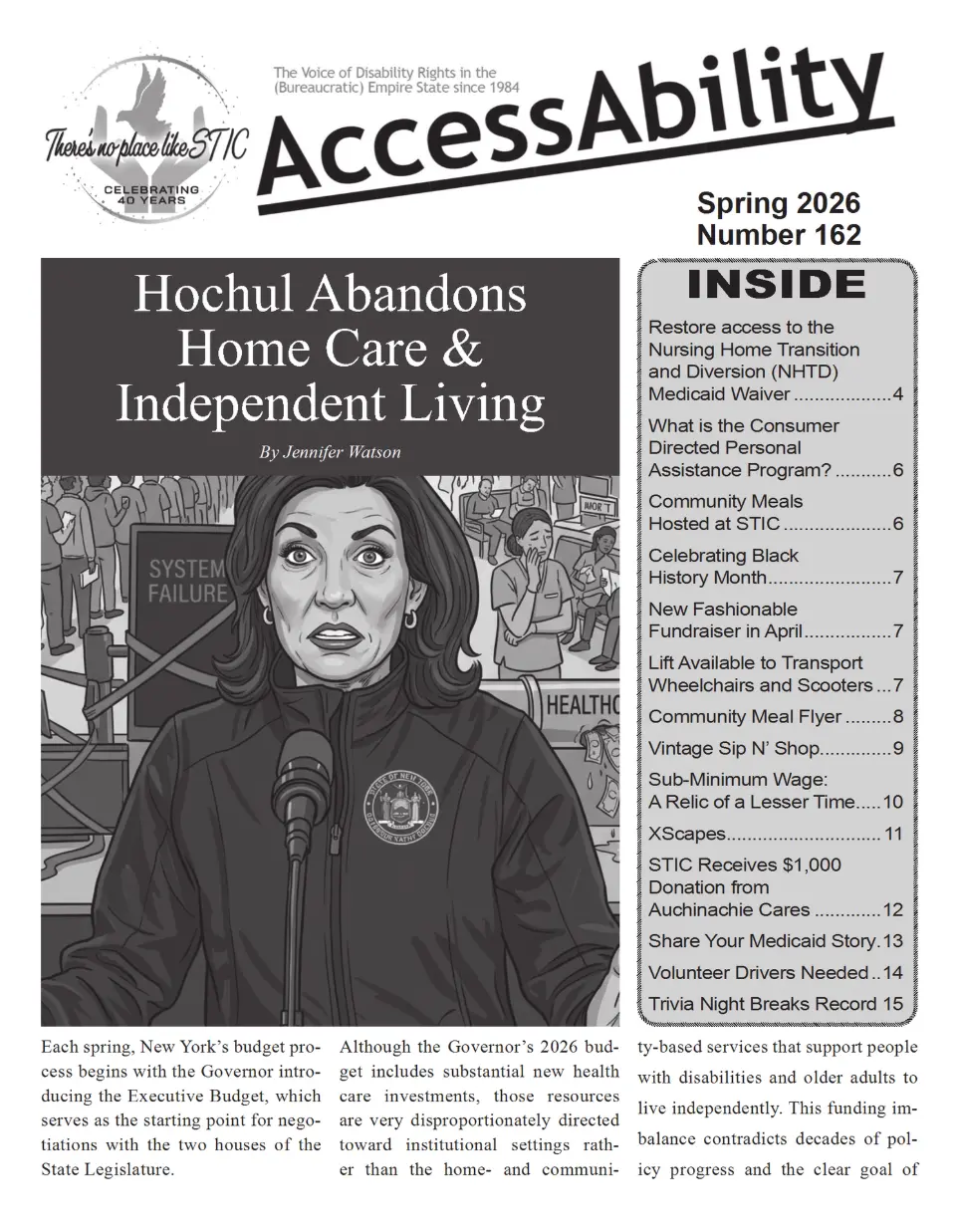
Hochul Abandons Home Care & Independent Living
By Jennifer Watson
Each spring, New York’s budget process begins with the Governor introducing the Executive Budget, which serves as the starting point for negotiations with the two houses of the State Legislature.
Although the Governor’s 2026 budget includes substantial new health care investments, those resources are very disproportionately directed toward institutional settings rather than the home- and community-based services that support people with disabilities and older adults to live independently..
Summer 2026
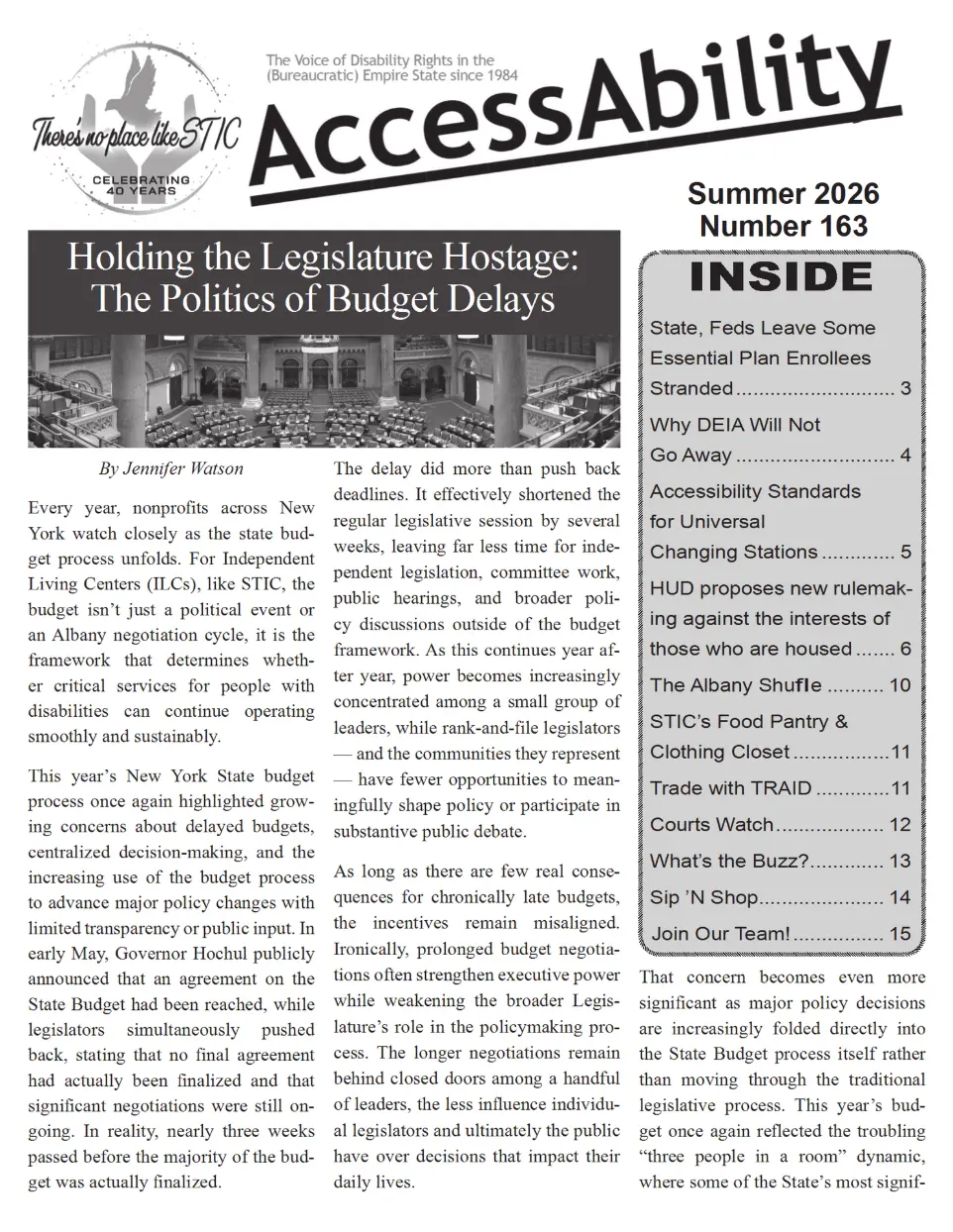
Holding the Legislature Hostage: The Politics of Budget Delays
by Jennifer Watson
Every year, nonprofits across New York watch closely as the state budget process unfolds. For Independent Living Centers (ILCs), like STIC, the budget isn’t just a political event or an Albany negotiation cycle, it is the framework that determines whether critical services for people with disabilities can continue operating smoothly and sustainably. This year’s New York State budget process once again highlighted growing concerns about delayed budgets, centralized decision-making, and the increasing use of the budget process to advance major policy changes with limited transparency or public input..
CONTINUE READING WEB VERSION DOWNLOAD PDF VERSION
